Report · 2026 · Liu, P., Chien, J., Kuhn, R., Henwood, B. F.
A Lifeline Delayed
SNAP disruptions among unhoused Angelenos during the October to November 2025 federal government shutdown.
The Supplemental Nutrition Assistance Program (SNAP) is the nation's primary nutrition assistance program, designed to ensure that individuals and families with very low incomes can meet basic food needs. Because SNAP is a means-tested entitlement, most people experiencing homelessness meet the program's income eligibility criteria. For individuals living in extreme poverty, SNAP benefits often represent one of the few stable resources available to help prevent severe food deprivation.
In October 2025, a federal government shutdown disrupted funding for several federal programs, including SNAP. In California, benefits are issued on a staggered schedule during the first ten days of each month. Because the shutdown affected SNAP funding at the beginning of November, individuals scheduled to receive benefits early in the month were more likely to experience delays, while those scheduled later were largely unaffected once federal funding was restored.
That timing effectively created a natural experiment: some recipients experienced unexpected delays while others received benefits as scheduled, allowing us to examine whether disruptions in SNAP benefits directly affected food insecurity.
The headline numbers
- participants completed the November 2025 survey
- 410participants completed the November 2025 surveyDistributed on 17 November 2025, during the shutdown.
- had received SNAP before the shutdown
- 49.5%had received SNAP before the shutdown203 of 410, although most are likely eligible.
- experienced a delay or disruption
- 39%experienced a delay or disruption158 people: 60 reported a delay, 98 received no benefits at all.
- rise in going a whole day without eating
- +7 pprise in going a whole day without eatingFrom 37.3% in October to 44.3% in November, among those disrupted.
PATHS November 2025 monthly survey.
Why interruptions hit harder here
Despite the program's intent, many people experiencing homelessness do not consistently receive SNAP benefits. Administrative barriers, including difficulties maintaining documentation, replacing lost Electronic Benefit Transfer (EBT) cards, completing recertification requirements, or maintaining reliable contact information, can interrupt participation even among those who are eligible.
Interruptions may be particularly consequential for people experiencing homelessness. Unlike many low income households, they often lack food storage, cooking facilities, or reliable transportation to reach food resources. They may also have limited access to informal support networks that could buffer a temporary financial disruption, or a vehicle to drive to a food bank. As a result, even short delays in benefits can quickly translate into missed meals or severe food deprivation.
How this was studied
PATHS is a monthly cohort study that tracks health, housing, and service needs among a panel of people experiencing homelessness in Los Angeles County, through monthly online surveys distributed by email and text message.
Participants report their enrollment in SNAP at baseline and twice a year thereafter, in January and July. In the November 2025 monthly survey, distributed on 17 November 2025, a question was added assessing whether respondents experienced delays or did not receive SNAP benefits because of the shutdown. This report focuses on the 410 participants who completed that survey.
Two questions are addressed. First, who among people experiencing homelessness receives SNAP benefits? This is described from each participant's most recent baseline or biannual survey before the shutdown, with differences between groups assessed using standard statistical tests, and supplemented by looking at SNAP participation across repeated waves to see whether receipt is stable. Second, did delays worsen food insecurity? Food insecurity reported in October, before the shutdown, is compared with November, during it, using within-person comparisons.
For the second analysis, participants who reported a shutdown-related delay are treated as active SNAP recipients regardless of their previously reported enrollment status, while those reporting no disruption include both recipients who received benefits normally and individuals not currently enrolled.
Who receives SNAP
Among the 410 participants completing the November survey, 203 (49.5%) reported having received SNAP benefits in a survey prior to the shutdown.
Participation varied across sociodemographic and housing characteristics. Women made up a larger share of SNAP enrollees than non-enrollees (50.7% vs. 40.1%). Non-Hispanic White participants represented a larger share of enrollees than non-enrollees (38.9% vs. 21.3%); in contrast, Hispanic/Latino and non-Hispanic Black/African American participants were disproportionately represented among those not enrolled (Hispanic/Latino 46.4% vs. 32%; Black/African American 25.1% vs. 19.2%).
This pattern is consistent with prior research documenting racial and ethnic disparities in SNAP participation among eligible low income households, often linked to structural inequities, discrimination, and concerns related to immigration policy, underscoring the need for culturally responsive and targeted outreach.
Participants reporting substance use conditions were more represented among enrollees than non-enrollees (38.9% vs. 25.6%). One possible explanation is that engagement with behavioral health or treatment services may facilitate connection to public benefits.
Housing history also showed a strong association. While over 83% of participants reported experiencing chronic homelessness, they were significantly less likely to report being enrolled in SNAP compared with those who were not chronically homeless (88.4% vs. 79.3%). SNAP enrollment also differed by primary shelter status in the past month, with unsheltered individuals overrepresented among non-enrollees (73.4% vs. 63.1%), while sheltered individuals were more represented among enrollees (36.9% vs. 26.6%). These findings align with existing evidence that unsheltered and chronically homeless individuals face greater barriers to maintaining service access.
Table 1. Sociodemographic, health and housing characteristics by SNAP enrollment status
Percentages, at each participant's most recent assessment before the shutdown.
| Variable | Total (N=410) | Enrolled (N=203) | Not enrolled (N=207) |
|---|---|---|---|
| Age 18-29 | 14 | 16 | 12.1 |
| Age 30-44 | 46 | 48 | 44 |
| Age 45-59 | 33 | 29.6 | 35.8 |
| Age 60 and older | 7 | 6.4 | 8.2 |
| Male* | 54 | 48.3 | 59.9 |
| Female* | 45 | 50.7 | 40.1 |
| Other* | <1 | <1 | 0 |
| White*** | 30 | 38.9 | 21.3 |
| Black/African American*** | 22 | 19.2 | 25.1 |
| Hispanic/Latino*** | 40 | 32 | 46.4 |
| Multiracial or other*** | 9 | 9.9 | 7.3 |
| Prior mental health conditions | 62 | 65 | 58.9 |
| Prior substance use conditions** | 32 | 38.9 | 25.6 |
| Chronically homeless* | 84 | 79.3 | 88.4 |
| Unsheltered in the past month* | 68 | 63.1 | 73.4 |
| Sheltered in the past month* | 32 | 36.9 | 26.6 |
Differences between groups were tested for statistical significance; p-values are shown as *p<0.05, p<0.01, *p<0.001.
Among participants with repeated SNAP assessments, approximately three quarters reported consistent SNAP status across surveys, while about one quarter changed enrollment status. These changes likely reflect common barriers to maintaining benefits among people experiencing homelessness, such as missed recertification deadlines, lost EBT cards, or difficulties maintaining documentation.
What the disruption did
Among the 410 participants completing the November survey, 158 individuals (39%) reported experiencing a delay or disruption in SNAP benefits during the government shutdown. Of these, 60 individuals (15%) reported a delay, while 98 individuals (24%) reported not receiving benefits during this period.
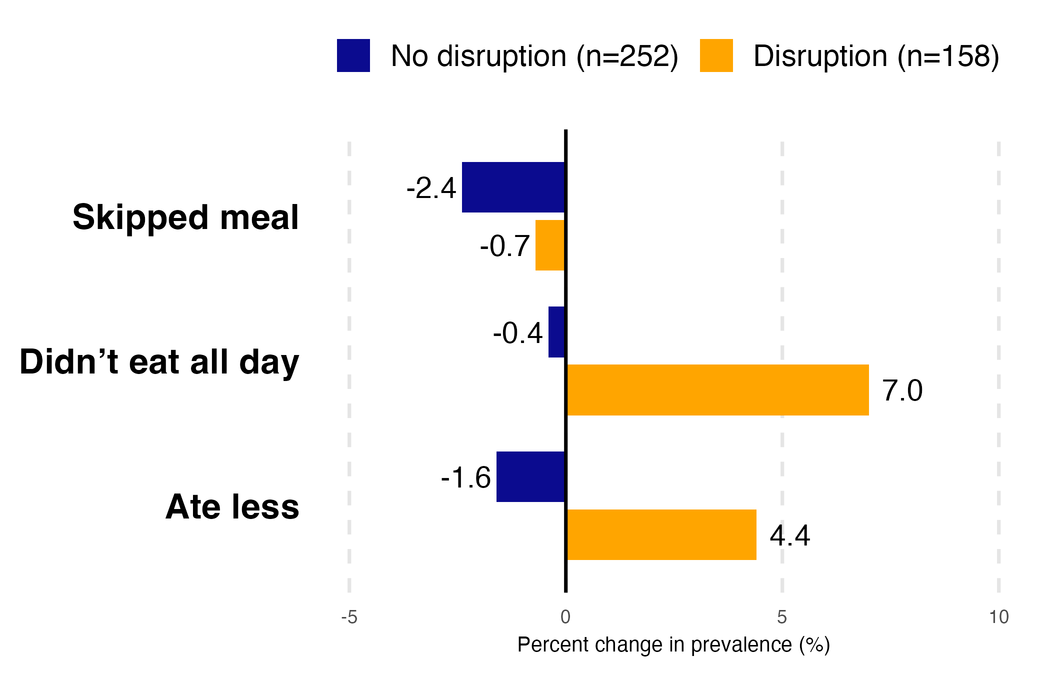
Among participants who did not report disruptions, food insecurity indicators showed minimal changes between October and November. Among those who did, the prevalence of the most severe form of food insecurity, going an entire day without eating, increased significantly from 37.3% in October to 44.3% in November, a 7 percentage point increase. Eating less increased modestly (4.4%) while skipping a meal showed a minor decrease, but neither change was statistically significant.
These findings suggest that delays in SNAP benefits may push individuals into the most severe forms of food deprivation, even when other food insecurity indicators did not change substantially.
Conclusion
SNAP plays a critical role in helping people experiencing homelessness meet basic food needs. Yet participation remains incomplete and benefits are not always stable over time.
This report demonstrates how delays in SNAP benefits can worsen severe food insecurity. Participants who experienced benefit disruptions were significantly more likely to report going an entire day without eating. The fact that these impacts were not even more pronounced may reflect some combination of the short duration of the cuts and the difficult reality that food insecurity levels were already so high, making it difficult for them to get much worse.
Three policy lessons
Given that more disruptions may be likely, and that enrollment and renewal requirements have become more onerous, three key lessons emerge.
1. Increase SNAP enrollment among people experiencing homelessness. Although most are likely eligible, only about half of participants reported receiving benefits at any given time. Expanding outreach and enrollment assistance at shelters, service agencies, meal programs, and encampments could improve participation. Targeted outreach is especially important given disparities in enrollment: non-White individuals, as well as those who were unsheltered or chronically homeless, were less likely to be enrolled, suggesting that those facing the greatest structural vulnerability continue to encounter barriers.
2. Reduce barriers to maintaining benefits. Even among individuals who receive SNAP, participation may be unstable due to administrative barriers. Simplifying recertification processes, improving systems for replacing lost EBT cards, and reducing documentation requirements could help stabilize benefit receipt. These renewal supports can be more seamlessly integrated into existing client contacts with homeless outreach, social service, and field medicine systems.
3. Prepare for administrative disruptions. The shutdown demonstrates that even short term disruptions can have immediate and serious consequences. Contingency planning for future shutdowns or administrative interruptions should include mechanisms to maintain benefit continuity and ensure access to emergency food resources. As during the initial days of the COVID-19 pandemic, emergency food services can be mobilized through a mix of food pantry information sharing, increased support for soup kitchens, and pop-up food service through service delivery or mutual aid organizations.